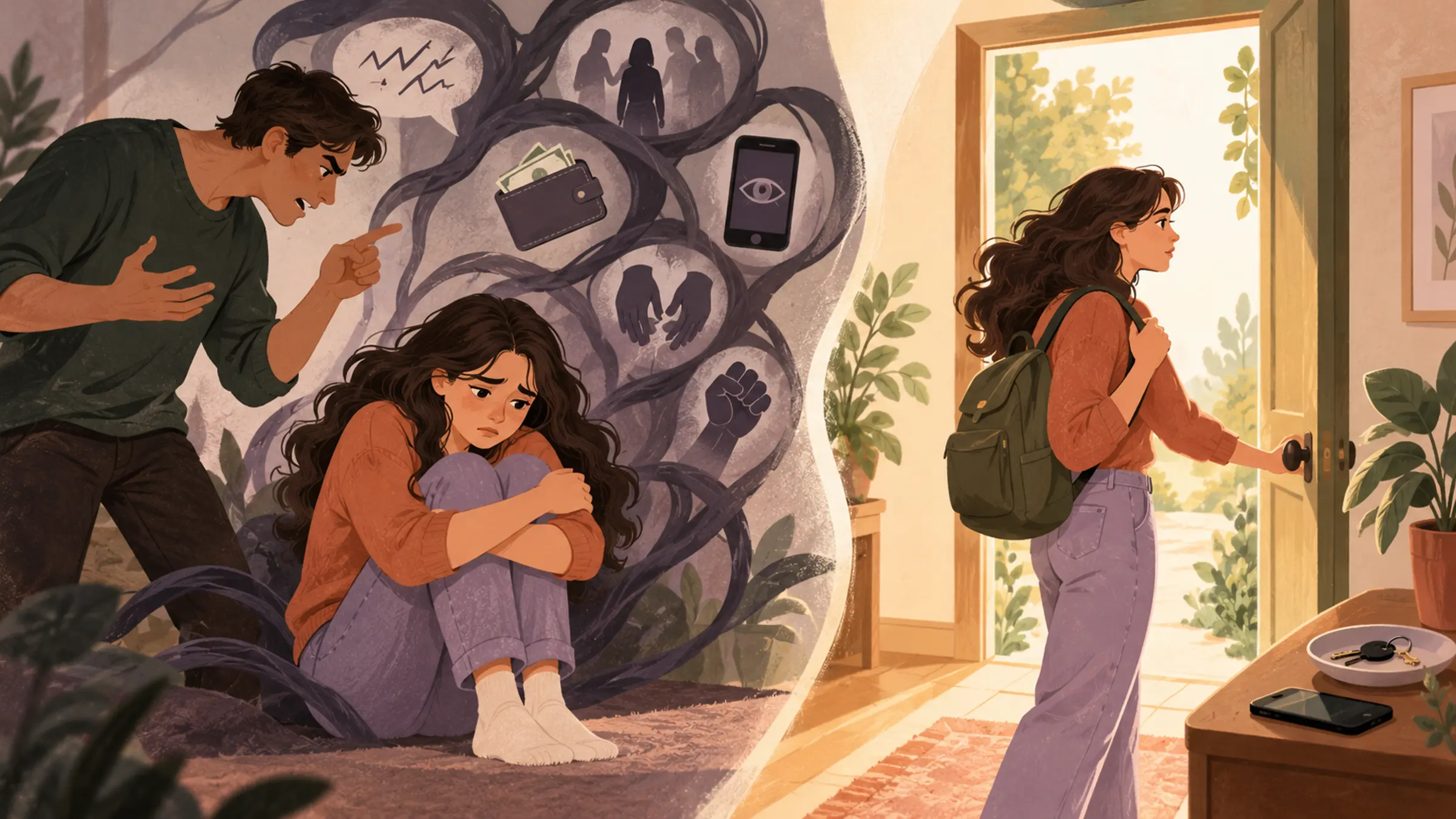
If you are asking, "why is my boyfriend so mean to me?", the most useful first answer is this: one bad mood does not define a relationship, but repeated meanness is a pattern worth taking seriously.
Maybe he snaps at you over small things. Maybe he talks to strangers politely, then comes home and treats you like you are annoying. Maybe he is sweet after the fight, but during the fight he calls you dramatic, stupid, needy, too sensitive, or impossible to love. So you end up studying your own behavior like a case file: Was I too emotional? Did I ask at the wrong time? Did I make him angry?
Start somewhere else.
Do not begin by deciding whether you are "too sensitive." Begin by naming what is happening. Is he stressed and handling it badly? Is he resentful but unwilling to talk directly? Is he criticizing you instead of solving the problem? Is he using anger to control what you say, wear, do, or ask for? Those are different situations. They need different responses.
This guide is not here to diagnose him. It is here to help you sort the pattern, protect your emotional safety, and decide what to say next.
What does it mean if your boyfriend is mean to you?
A mean boyfriend is not just a boyfriend who occasionally has a hard day. Everyone gets tired. Everyone says something clumsy sometimes. A healthier partner can usually notice the harm, take responsibility, repair, and change the pattern.
The concern is repetition.
It matters if he often:
- speaks to you with contempt
- calls you names
- mocks your feelings
- punishes you with silence
- blames you for his outbursts
- makes you afraid to bring up normal issues
- turns your hurt into evidence that you are the problem
- apologizes, then repeats the same behavior
In a healthy relationship, conflict can be uncomfortable without becoming degrading. You can disagree without being humiliated. You can ask for reassurance without being mocked. You can say, "that hurt me," without the entire conversation becoming a trial about your personality.
So the question is not only "why is he mean?" It is also "what happens after he is mean?"
Does he repair, or does he make you apologize for reacting?
A quick safety note before you try to fix it
If your boyfriend threatens you, scares you, blocks you from leaving, destroys things near you, monitors you, isolates you, pressures you sexually, controls your money, or says you deserve pain, treat that as a safety issue, not a communication issue.
The National Domestic Violence Hotline describes emotional abuse as non-physical behavior used to control, isolate, or frighten someone. Love Is Respect also explains that dating abuse can include emotional, verbal, financial, digital, sexual, and physical behaviors, not only physical violence.
If any of that sounds close to your situation, do not make "communicate better" your only plan. Talk to someone safe outside the relationship. If you feel in immediate danger, contact local emergency services. If you are in the U.S., The Hotline and Love Is Respect both offer confidential support.
You do not have to prove that it is "bad enough" before you ask for help.
Why is my boyfriend so mean to me?
There is rarely one neat reason. But most patterns fall into a few buckets. The bucket matters because some patterns can improve with accountability, while others become more dangerous when you keep trying to explain your pain to someone who benefits from ignoring it.
He is stressed, but he is using you as the release valve
Stress can explain irritability. It does not excuse cruelty.
He may be under pressure from work, money, family, school, health, or insecurity. He may not know how to say, "I am overwhelmed." Instead, he snaps at you, criticizes small mistakes, or acts like your normal needs are another demand.
This is the most repairable version only if he can own it.
Repair sounds like:
- "I was stressed, but I should not have spoken to you that way."
- "I need to take a break before I get sharp."
- "I am going to handle my stress differently."
Non-repair sounds like:
- "You know I am stressed, so why would you bring that up?"
- "If you did not push me, I would not be mean."
- "That is just how I talk when I am busy."
Stress explains context. Accountability decides whether the relationship is safe to keep building.
He is resentful, but he will not say the real issue
Sometimes meanness is indirect resentment. He may be upset about something he has not named clearly: feeling ignored, feeling insecure, wanting more space, feeling criticized, or doubting the relationship.
Instead of saying the real thing, he leaks it through sarcasm, coldness, dismissive jokes, or small attacks.
For example:
- "Wow, you finally remembered."
- "Must be nice to care only about yourself."
- "Do whatever you want. You always do."
The problem here is not that he has feelings. The problem is that he is making you solve a mystery while he punishes you for not already knowing the answer.
You can invite directness once:
"I can talk about what is bothering you, but I cannot respond to digs and sarcasm. If there is a real issue, say it directly."
Then watch what happens. A repair-capable partner will try to become clearer. A punishing partner will keep making you chase the problem.
He thinks criticism is the same as honesty
Some people believe being blunt gives them permission to be unkind. They call it honesty, logic, standards, or "just telling the truth."
But honesty without care becomes criticism. And repeated criticism can make you feel like you are always auditioning to be treated well.
The Gottman Institute names criticism and contempt as two of the major destructive patterns in conflict. Their repair guidance points toward gentle start-ups, respect, and specific complaints instead of attacking someone's character.
That distinction matters.
A specific complaint is:
"I felt ignored when you were on your phone during dinner."
A character attack is:
"You are selfish. You never care about anyone but yourself."
If your boyfriend regularly attacks who you are instead of naming what happened, he is not just being direct. He is making the relationship emotionally unsafe.
He is using anger to control the relationship
This is the bucket to take most seriously.
Control can look obvious: threats, monitoring, isolation, rules, pressure, or fear. But it can also look like mood management. You become careful all the time because his reaction sets the weather for both of you.
You might notice yourself thinking:
- If I ask this, he will explode.
- If I wear that, he will accuse me of wanting attention.
- If I see my friends, he will punish me later.
- If I say I am hurt, he will say I am manipulating him.
- If I leave the room, he will call me disrespectful.
That is not just "a mean boyfriend." That is a power problem.
Love Is Respect describes abuse as a pattern used to gain or maintain power and control. If his meanness makes you smaller, quieter, more isolated, or more afraid to disagree, focus less on finding the perfect sentence and more on getting support.
He has learned that apologies reset the clock
Some relationships run on a painful loop: he is cruel, you cry, he apologizes, things feel tender for a few days, then it happens again.
The apology may feel real in the moment. It may even be real emotionally. But an apology without behavior change is not repair; it is a pause.
Look for evidence after the apology:
- Does he name the behavior without blaming you?
- Does he ask what would help you feel safe again?
- Does he change what happens next time?
- Does he accept a boundary without punishing you?
- Does he get outside help if the pattern keeps repeating?
If the answer is no, the apology is not enough to build trust on.
He wants the benefits of closeness without the responsibility of care
Some people want a partner who comforts them, waits for them, forgives them, listens to them, and makes life easier, but they do not want the responsibility of treating that partner gently.
This can feel confusing because he may not be mean all the time. He may be affectionate when he wants comfort. He may be sweet when he is afraid of losing you. He may say he loves you and still act careless with your feelings.
Love matters. But love is not the whole test.
The better question is: does his love make room for your dignity?
Stress, resentment, and controlling behavior
| Pattern you observe | What to discuss or do |
|---|---|
| A harsh response during a difficult day, followed by responsibility and repair | Name the words that hurt and agree on a calmer way to ask for space. |
| Recurring complaints about an unresolved issue | Discuss one concrete concern, such as chores or time together, and agree on a specific change. |
| Repeated insults, humiliation, or contempt | Take the pattern seriously and consider individual support as you decide your boundaries. |
| Threats, monitoring, isolation, sexual pressure, or fear of retaliation | Prioritize safety and confidential support. A joint confrontation can increase risk. |
Stress can be part of the context. Responsibility for hurtful behavior belongs to the person doing it. A label is less useful than an accurate description of what happened and whether you feel safe.
Signs your boyfriend being mean is a red flag
The strongest red flags are not always the loudest moments. They are the patterns that train you to abandon yourself.
You rehearse normal conversations because you are afraid of his reaction
You should not need a legal brief to ask for kindness.
If you spend hours planning how to bring up a normal concern, that tells you something. It may mean past conversations taught you that your feelings will be punished.
He turns every issue into your fault
You bring up his tone. He says your timing was bad.
You say the name-calling hurt. He says you are too sensitive.
You ask for a real conversation. He says you are starting drama.
Over time, the original issue disappears. The new issue is always your reaction.
He is kind in public and cruel in private
Everyone has different public and private sides. But if he is consistently respectful to other people and unusually harsh with you, do not accept "I cannot control it" too quickly.
He may be showing you that he can control it when there are consequences.
You feel relief, not closeness, when things are good
Healthy peace feels connected. Unhealthy peace feels like the storm has temporarily passed.
If the good days mostly make you think, "thank God he is not mad," pay attention to whether you feel free to disagree, set limits, or ask for help. Fear of his reaction deserves support; you do not have to wait for a diagnosis or label.
He says cruel things, then expects instant forgiveness
Repair takes more than "I said sorry." If he expects your hurt to vanish on his timeline, he is still centering himself.
You are allowed to need time.
A three-step conversation when you feel safe
- Name the behavior. “Yesterday you called me stupid when we disagreed about money.”
- State the impact and boundary. “That hurt. I want us to discuss the budget respectfully. I will pause a conversation that includes insults.”
- Ask for a specific change. “Can we agree to take a break when we get heated and return to the budget tomorrow?”
Choose a time when you can leave the conversation safely. Notice whether he acknowledges what happened, respects the boundary, and follows through over time. You can seek support if the pattern continues.
If you fear his reaction, talk privately with a trusted person or a domestic-abuse advocate before raising the issue. In the United States, the National Domestic Violence Hotline offers confidential support by phone at 800-799-SAFE (7233), by texting START to 88788, and online. Use a safer device if your activity may be monitored. For immediate danger, contact local emergency services. The Hotline
For communication patterns, read contempt in relationships. The Should We Break Up? quiz offers reflection prompts. Base safety decisions on your circumstances and appropriate support.
What if he says you made him mean?
You can influence a conversation. You cannot make another adult choose cruelty.
Maybe you were anxious. Maybe you asked at a bad time. Maybe you interrupted. Maybe you also need to work on how you communicate. That still does not make name-calling, threats, humiliation, or intimidation your fault.
A healthier version of conflict sounds like:
"I am too activated to talk well. I need twenty minutes."
Not:
"Look what you made me say."
This distinction is important because many people stay too long trying to become perfect enough to stop someone else's meanness. You can become calmer, kinder, clearer, and more patient, and still not be able to love someone into respecting you.
Record the behavior, not a diagnosis
If it is safe to reflect privately, describe one incident in ordinary terms: what happened, what you asked for, how he responded, and what happened afterward. “He called me stupid when I disagreed” is more useful than trying to decide whether he has a particular personality disorder.
An illustrative contrast: an apology followed by respectful disagreement next time gives you different information from an apology followed by pressure to erase the incident. Neither one incident nor a polished apology can establish lasting change. You also do not need a complete record to decide that you feel unsafe or want to leave.
Do not keep notes on a shared or monitored device, provoke another argument to collect proof, or show a record to someone who may retaliate. The purpose is clarity for you, not building a case you must win before receiving support.
Can a mean boyfriend change?
Yes, but only under specific conditions.
Change is possible when he:
- names the behavior without minimizing it
- stops blaming your reaction for his behavior
- accepts boundaries without punishing you
- repairs without rushing you
- changes the next conflict, not just the next apology
- seeks help if anger, contempt, or control keeps repeating
Change is unlikely when he:
- says "that is just how I am"
- says all couples talk this way
- calls your boundary controlling
- becomes kind only when you are about to leave
- scares you, threatens you, or isolates you
- makes you feel responsible for managing his emotions
Do not measure change by how emotional the apology is. Measure it by what happens the next time he is upset.
Should you break up with him if he keeps being mean?
You do not have to decide everything today. But you do need to stop treating repeated harm as a puzzle you can solve alone.
Ask yourself:
- Do I feel emotionally safe telling the truth?
- Does he repair without making me beg?
- Are my friendships, work, sleep, or self-respect shrinking?
- Am I staying because the relationship is good, or because leaving feels scary?
- If nothing changed for six more months, would I be okay?
But if you are afraid of him, do not center the breakup conversation as your first step. Center safety, support, and planning.
A final note
You may love him. He may have good moments. He may be wounded, stressed, ashamed, or confused. None of that means you are required to be the place where his worst behavior lands.
The question "why is my boyfriend so mean to me?" can become a trap if it keeps you studying him while ignoring what the relationship is doing to you.
So ask one more question:
Do I become more myself in this relationship, or do I keep getting smaller to survive it?
That answer matters.
Written by Intimate Relationships for reflection and relationship education. Editorial policy · Report a correction