
Date Night Questions
A free date night questions game for couples who want guided prompts instead of another static list.
Start Playing in 3 Steps
- 1
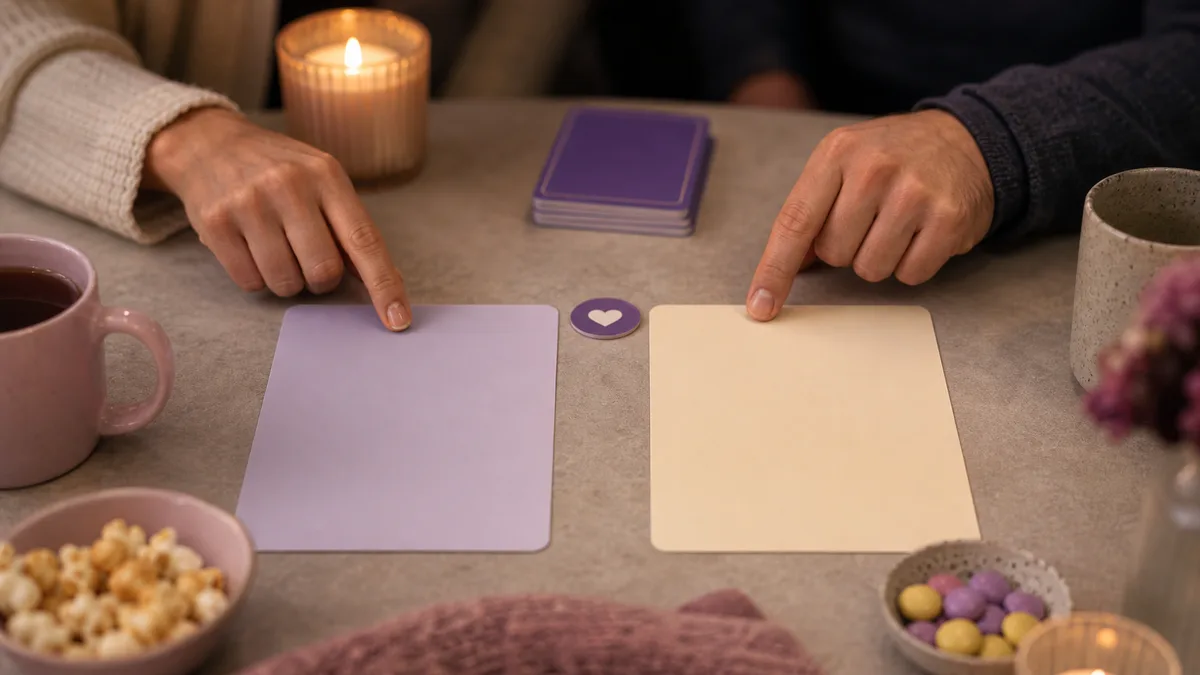
Draw a date-night card
Pick a question that fits the mood at the table.
- 2
Answer with a detail
Each person gives one concrete example, memory, or preference.
- 3
Turn it into talk
Use the follow-up to make a plan, recall a story, or ask why.

Question Deck
What is one tiny habit you want us to keep?
When do you feel most understood by me?
What topic have we been avoiding because it feels annoying, not impossible?
What is one thing you wish I noticed without you having to explain it?
What does a good ordinary week look like for us?
Where do we make each other laugh the easiest?
What is one repair attempt that works for you?
What kind of affection feels most natural right now?
What would make our next date feel like ours?
What small thing made today feel easier?
What ordinary moment with us still feels good?
What is Date Night Questions?
Date Night Questions is a playable couple questions game for partners who want a date to feel more intentional without turning it into a serious relationship meeting. Instead of scrolling a long article of prompts, you open a small deck, answer one question at a time, and use the follow-up only when the first answer needs more detail. The free 10-card mode works for dinner, a walk, a quiet night at home, or the first few minutes after a movie when both people want to talk but do not want to invent the topic.
Most date night questions pages give couples a useful list, but the work is still on the reader: choose a question, remember where you stopped, and decide whether the mood should be light or deep. This page turns that search intent into a game flow. You start a round, draw a prompt, answer in turns, and move to the next card when the conversation is ready.
The deck is written for couples who already know each other and want better conversation, not pressure. Some cards are warm and easy, some ask for a memory or preference, and some invite a practical plan. That makes it useful as a date night conversation starter and as a couple questions game you can replay later.
Why it works for couples
A good date night conversation usually needs enough structure to begin and enough freedom to become personal. This deck gives both. The main question keeps the moment focused, while the follow-up helps each partner give an example, explain a preference, or turn the answer into a small next step. That format keeps the game lighter than a deep relationship audit but more useful than random small talk.
The strongest search results for this topic tend to organize questions by lists, themes, or printable resources. That is helpful when someone wants many options. The gap is the actual play experience. Date Night Questions fills that gap by making the next action obvious: draw a card, answer, ask the follow-up if needed, then continue or stop.
For couples, that pacing matters. One person does not have to host the whole conversation, and the other person does not have to guess what kind of answer is expected. The card gives enough context to make the first answer safe and specific.
- Use one prompt when the night is short.
- Use 10 cards for a complete free round.
- Use unlimited mode when the conversation is already flowing.
How the gameplay works
Start the game, choose the 10-card mode, and let the deck show one date night question at a time. Both partners answer the visible question before either person corrects, debates, or explains too much. If the answer feels short, use the follow-up line on the card. If the answer already opens a good story, stay there and let the game wait.
The 10-card mode is free and works like a focused mini deck. It is enough for a dinner conversation or a short couch-night reset. The unlimited mode is better when you want a longer couple questions game and do not want to stop after the first round.
The best rhythm is simple: one person reads, both answer, then one person asks the follow-up. Do not rush through every card. The win condition is not finishing the deck. The win condition is getting one answer that helps you know each other a little better.
How to use these questions on a real date night
Pick the setting first, then let the deck match the energy. At dinner, choose lighter questions that invite stories, preferences, and small memories. On a walk, use prompts that are easy to answer without staring at the screen. At home, use the follow-up question to turn a funny answer into a plan for the next date, weekend, or small habit you want to repeat.
If a question feels too personal for the moment, skip it. A date night questions game should create closeness by consent, not by pressure. You can always return to a deeper card when the mood is calmer or when both people have more time.
If the conversation becomes useful, stop playing for a few minutes. That is not a failed round. It means the card did its job. Come back to the deck when the thread naturally ends.
When to play
Play Date Night Questions when the two of you want connection but do not want a heavy talk. It works before dinner arrives, after the dishes, during a low-key walk, in a hotel room on a weekend trip, or any time the relationship has been running on logistics and needs a warmer entry point. The deck is also useful when one partner says, "I want to talk, but I do not know what to ask."
Use the free 10-card mode when time is limited or when one person is tired. A short round lowers the commitment and makes it easier to begin. Use unlimited mode when the night is already set aside for conversation and you want the game to keep serving fresh prompts.
This page is not meant to replace serious relationship support. If a prompt uncovers a real conflict, pause the game and handle the topic with more care. For ordinary date nights, the deck is built to keep curiosity alive.
What you can take away
The most useful outcome is not a perfect answer. It is one concrete detail you can remember: a memory your partner still loves, a small habit they want repeated, a date idea that feels realistic, or a moment when they felt understood. That is why the deck combines date night questions with follow-ups instead of leaving every answer floating.
After a round, choose one takeaway together. It might be a plan for the next date, a tiny ritual to keep, or a topic to revisit when you have more time. Turning one answer into one action gives the conversation a reason to matter after the game ends.
If you want something lighter next, try a daily couple question. If you want something deeper, move to a deep-talk deck. If you want a more playful decision, use a This or That date-night game. Keeping those paths separate helps each page own a clear search intent.
Use the result to start a conversation.
These activities are written and published by Intimate Relationships. Quizzes reflect the answers you choose; they are not clinical assessments and cannot establish what another person feels. Games offer optional prompts. You can skip a question or stop at any time.
Read our editorial standards or report a problem. If you are worried about your safety, seek appropriate support rather than relying on a score.
Play next


Frequently Asked Questions
Is Date Night Questions free to play?
Yes. The 10-card date night questions mode is free to play. You can start a round, answer the prompts together, and use the follow-ups without logging in. Unlimited mode is available when you want a longer session.
How is this different from a list of date night questions?
A list gives you ideas to browse. This page turns those ideas into a guided couple questions game: one card appears at a time, the follow-up is built in, and the 10-card flow gives the conversation a clear start and stopping point.
Can we play this on a phone during dinner?
Yes. The game is designed for mobile browsers. One person can hold the phone, read the card, and pass it back and forth, or both people can answer before moving to the next prompt.
What kinds of questions are in the deck?
The deck mixes warm-up questions, playful memory prompts, practical date-night ideas, and deeper follow-ups. The goal is to help couples move from easy answers into better conversation without making the night feel intense.
What should we do if a question feels too serious?
Skip it or pause the game. Date night questions should help both people feel curious and safe. If a prompt opens a real issue, come back to it outside the game when there is enough time and care to talk well.
50 Road Trip Questions for Couples
These road trip questions for couples give you something to talk about without making the whole drive an interview. Start with a small choice: “Would you rather plan every stop or leave room for a detour?” or “What makes a travel day feel comfortable to you?” Pick a few, take turns and leave space for the answer—or for silence.
The 50 prompts below are grouped by mood. They work for newer couples as well as people who have traveled together for years; skip any question that does not fit your trip.
Before you start: put the drive first
Choose a few prompts before leaving, or let a passenger read them aloud. The driver should not read a screen or operate a device while driving. Even a conversation can take attention away from the road: the National Highway Traffic Safety Administration (NHTSA) includes talking to passengers among possible distractions. Pause the conversation whenever traffic, weather, navigation or the driver's attention calls for quiet. A passenger reading the questions does not eliminate that distraction.
Either person can pass, answer later or simply listen. Agreeing on those limits is one way to respect each other's boundaries; a question is an invitation, not a demand.
Travel preferences and comfort
- Would you rather plan every stop or leave room for a detour?
- What makes a travel day feel comfortable to you?
- How early do you like to leave for a long drive?
- Would you choose a scenic route or the quickest route if both fit the day?
- What kind of break helps you feel ready for the next stretch?
- Do you prefer a full itinerary or one main plan each day?
- What snack would you pack twice because it disappears so quickly?
- How do you like to decide when it is time to stop for food?
- What is one small thing you like having within reach on a trip?
- When do you most enjoy quiet during a journey?
Light and imaginative road trip prompts
- If this trip had a playful title, what would you call it?
- What unusual roadside attraction would you be curious to visit?
- If we could add an extra day anywhere, what kind of place would you pick?
- Which fictional character would make an entertaining travel companion?
- If our car could have a nickname for this trip, what would it be?
- What unlikely combination of snacks would you put on a road trip menu?
- If you could borrow any vehicle for a day, what would you choose?
- What kind of tiny museum would you invent for a town?
- If we made a travel playlist with one unexpected theme, what would it be?
- What harmless travel mishap would make a funny chapter title later?
Memories from past journeys
- What is a journey you remember for the people who were with you?
- Which trip meal was more memorable than you expected?
- What is a place you visited briefly but still think about?
- What did your family or friends do on trips that you would happily repeat?
- Have you ever changed a travel plan and enjoyed the result?
- What was a small kindness someone showed you while traveling?
- Which sound or smell brings a past trip back to you?
- What is something you packed once and never needed?
- What travel memory makes you laugh now, even if it was frustrating then?
- Is there a journey you would like to tell me more about sometime?
Choices to make together
- How can we tell each other when we need a break without making it a debate?
- What would make a food stop feel easy for both of us?
- How should we choose between two activities when we each prefer a different one?
- What is a comfortable way to share navigation or planning tasks?
- How much flexibility should we leave in the plan for today?
- What would you like me to know about how you feel when plans change?
- If one of us wants quiet, how can we signal that kindly?
- What is one expense we should agree on before an unplanned stop?
- How can we make room for both of our interests on this trip?
- What would help us end a long travel day on a calmer note?
Future trips and small plans
- What kind of place would you enjoy exploring on a free weekend?
- Is there a nearby town you would like to visit for the first time?
- What season would you choose for a trip that has no strict schedule?
- What simple activity would you like to try together away from home?
- Would you rather return to a favorite place or discover somewhere new?
- What would a low-cost day away look like for you?
- What is a travel skill you would like to learn or practice?
- Is there a person you would like us to visit on a future trip?
- What is one thing we could do to make our next journey less rushed?
- What is a small trip we could realistically plan in the next few months?
Pick the right question for the moment
If you have just set off or one person is tired of talking, try a simple preference or take a quiet break. If you both want a longer conversation, a memory or a shared choice can open one naturally. You do not need to agree on every answer: a different preference is useful information for planning the next stop.
For a conversation after the trip, try a relationship check-in or explore what intimacy can mean. If you would like a guided activity while safely parked or at home, use the Date Night Questions activity above. For a sensitive subject, our guide to healthy boundaries can help you discuss what each person wants to share.
If the driver gets tired
Questions, music and open windows are not substitutes for sleep. NHTSA's drowsy-driving guidance emphasizes adequate sleep and warns that coffee alone may not be enough. If the driver feels drowsy, stop in a safe place to rest or change drivers when appropriate. Do not treat a lively conversation as proof that it is safe to continue.