Key takeaways
- The honeymoon phase describes early excitement; it is not a relationship test.
- Strong feelings do not establish shared expectations or compatibility.
- A change in texting or intensity needs context, not an automatic verdict.
- You can enjoy a new connection while keeping your own pace and boundaries.
Enjoy the excitement of a new connection while keeping feelings, what you know and what you have agreed separate.

The honeymoon period in dating is a common label for the early excitement of getting to know someone: looking forward to seeing them, enjoying discovery and feeling strongly drawn to the possibilities. It is not a diagnosis or a required stage. Some people describe an intense beginning; others develop interest more gradually.
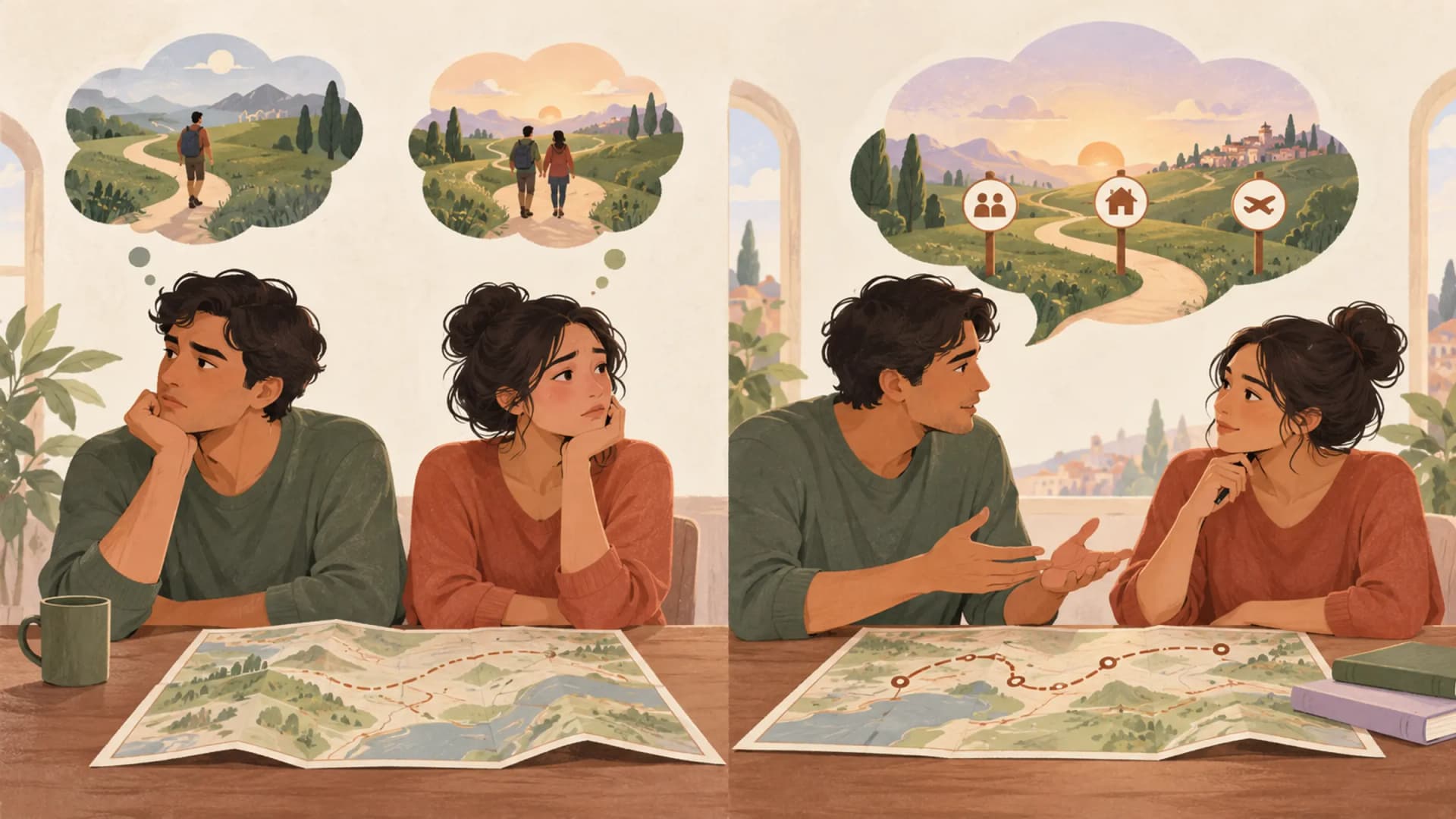
The useful distinction is between what you feel, what you know and what you have agreed. You can be excited about someone while still learning whether your lives and expectations fit. Enjoying the beginning does not require treating a possible future as a promise.
What people mean by the honeymoon phase
The Gottman Institute's honeymoon phase explainer describes early attraction, anticipation and an especially positive view of a partner. This is a general description, not a checklist that every relationship must satisfy.
You might replay a conversation, look forward to the next date or find small discoveries unusually interesting. You might want frequent contact or physical affection. Someone else may enjoy the connection without wanting constant messages, sex or touch. None of these preferences is a requirement to prove interest.
Excitement can coexist with real closeness. It can also coexist with large gaps in what you know about one another. Our guide to intimacy and infatuation explores that conceptual difference; here, the practical question is what conclusions early excitement can reasonably support.
Keep feelings, knowledge and agreements separate
A lovely date tells you something about that date. It does not settle whether you are exclusive, how you will handle a disagreement or whether you want the same kind of partnership.
| What is happening | What it gives you | What still needs learning or discussion |
|---|---|---|
| You look forward to their messages | Information about your own interest | Whether the contact rhythm works for both of you |
| You spend several weekends together | Shared experiences you enjoyed | Whether either person expects that schedule to continue |
| You imagine a trip or a shared home | A possibility you find appealing | Whether both people want it and can realistically commit |
| A first difference appears | A specific issue to understand | Whether you can discuss it without pressure or punishment |
This is an editorial planning aid, not a compatibility score. You do not need to stage an argument to learn about someone. Ordinary plans, changed preferences and questions offer enough to discuss without manufacturing a test.
If you want exclusivity, ask about what being exclusive means. Frequent contact is not a substitute for a shared agreement, and agreement about exclusivity does not automatically settle every other expectation.
How long does the honeymoon phase last?
There is no single deadline that tells you what your relationship should feel like. General explainers, including Gottman's, describe ranges from weeks or months to a year or two. Those broad estimates are not a countdown for an individual couple, and they do not tell you whether a particular change is welcome.
You may notice that the urgent wish to message all evening becomes a more manageable rhythm. You may keep feeling excited while discovering differences. You may also decide that you do not want to continue. Calling any of these a phase does not decide what to do next.
Instead of asking whether you have reached the correct month, name the change: “We used to arrange our next date before leaving. Lately I have been unsure whether we have a plan.” That gives the other person something specific to answer. It also lets you hear a response you may not have expected.
Two changes that can look similar on a phone
Hypothetical example: Two people used to message throughout the working day. One starts a job where personal calls are difficult. They explain the change, agree to catch up in the evening and continue making plans both enjoy. Fewer daytime messages do not, by themselves, tell you that their interest has disappeared.
Hypothetical contrast: In another connection, messages become less frequent and several plans are canceled without an alternative. The person asking about it is told to stop being difficult. The issue worth discussing is the missing plans and dismissive response, rather than trying to prove when the honeymoon phase ended. That pattern does not reveal a hidden motive, but you can decide whether the available connection works for you.
You do not have to accept repeated hurt as a necessary stage on the way to a deeper relationship. Equally, one busy day is too little information to explain a whole relationship. The NHS guidance on healthy relationships recommends listening, checking your understanding and discussing boundaries. Those actions address the actual situation more directly than assigning a phase label.
Enjoy the beginning without giving up your own pace
You can make room for a new person while keeping friendships, rest, work and private time. You do not need to cancel a class every week to show that you care, or agree to a trip because saying no might spoil the mood.
For example: “I would like to see you on Sunday. I am keeping Thursday for my class.” Or: “The trip sounds fun, but I am not ready to book something that far ahead. Could we plan a day out first?” These are illustrative words, not formulas for getting the answer you want.
Love is respect's boundary guidance applies during early dating as well as later relationships: ask about another person's limits and respect the answer. Affection does not create an obligation to share passwords, disclose private experiences or agree to touch. Our guide to taking a relationship slowly offers more language for discussing pace.
When the excitement changes, ask a smaller question
“Are we out of the honeymoon phase?” may be less useful than one of these:
- What have we stopped doing that either of us actually misses?
- Is there a practical limit or a preference we have not discussed?
- Do we both still want to make plans, even if the feeling is less urgent?
- Is there an agreement we want to change, or something we never agreed in the first place?
Choose the question that fits what you observed. If you still want the relationship, you can propose one change and hear whether the other person wants it too. If your question is whether a quieter bond feels wanted or merely comfortable, read calm love after chemistry. That is a different decision from identifying early excitement.
You do not have to preserve the most intense week of dating. You also do not have to stay because someone says fading excitement always means deeper love. Keep enough room to enjoy what is happening, learn what remains unknown and say what you actually want.
FAQ
What is the honeymoon phase in dating?
It is a common label for an early period of excitement, attraction and discovery. It is not a diagnosis, a required stage or proof that both people want the same future.
How long does the honeymoon phase last?
There is no single deadline for your relationship. General descriptions range from weeks or months to a year or two, but these estimates cannot tell you when your feelings should change. Discuss the actual change you notice.
Does less texting mean the honeymoon phase is over?
Not by itself. Work, preferences, familiarity or a change in interest may affect contact. Ask about the change and notice whether plans and agreements still work for both people rather than assuming a motive.
Is it bad if we never had a honeymoon phase?
A relationship does not have to begin with overwhelming excitement. What matters is whether you want this connection and can learn about each other with respect. You also do not owe someone romance simply because they treat you well.
Written by Caleb Merridan for reflection and relationship education. Editorial policy · Report a correction