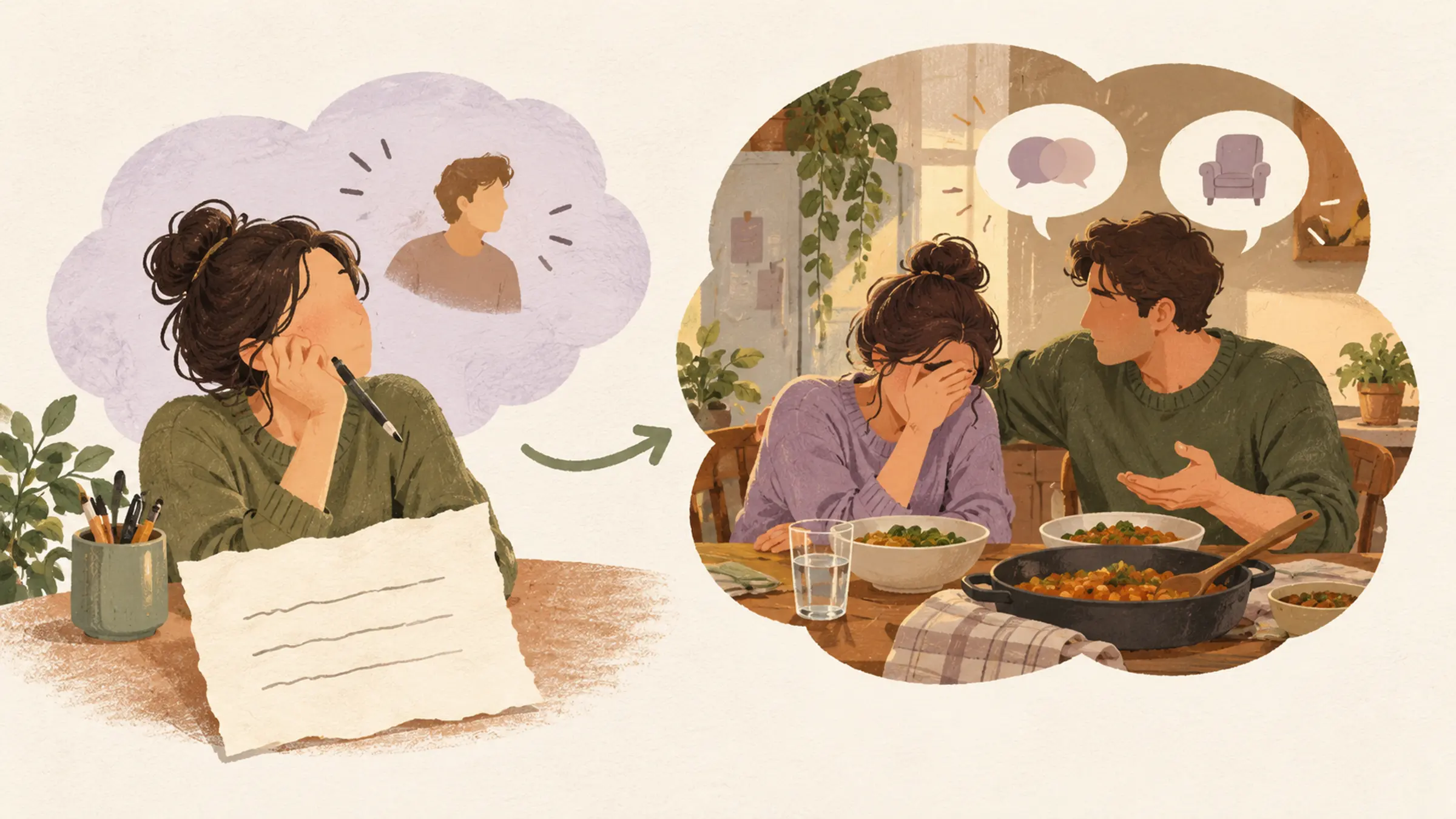
Words to describe someone you love include thoughtful, steadfast, tender, playful, attentive, and beloved. Words for being in love include safe, electric, peaceful, vulnerable, and grounded. Choose whether you are describing the person, the feeling, or your bond—then show what the word means with one real detail.
Choose a word by what you want to express
Use this table as a starting point. The same word can feel beautiful or too much depending on the relationship, timing, and tone.
| What you mean | Words to try | What they suggest | Use when |
|---|---|---|---|
| Emotional safety | secure, safe, peaceful, steady | Love feels trustworthy, not chaotic | You want to describe calm attachment |
| Tenderness | gentle, warm, soft, affectionate | Love feels kind and emotionally careful | You want a sweet but not dramatic word |
| Admiration | adored, cherished, valued, treasured | You deeply appreciate who they are | You are writing a personal note |
| Desire | magnetic, drawn, enchanted, captivated | Love includes attraction and pull | You want romantic energy without sounding possessive |
| Commitment | devoted, loyal, chosen, committed | Love is a decision, not only a mood | You want to describe long-term love |
| Trust | reliable, honest, open, faithful | Love has consistency and truth | You want to name emotional security |
| Comfort | familiar, home, easy, grounded | Love feels like rest and belonging | You want to explain peace, not boredom |
| Longing | missed, yearned-for, irreplaceable | Distance makes the feeling visible | You want to describe absence or reunion |
| Respect | honored, understood, accepted, seen | Love protects personhood | You want to avoid making love sound like control |
| Mature love | patient, resilient, forgiving, accountable | Love can repair and keep growing | You want words for real life, not fantasy |
Words to describe someone you love
Choose a quality you have actually noticed, then add a specific detail. These are illustrative sentences to adapt, not claims about your partner.
| Word | What it describes | Example sentence |
|---|---|---|
| Thoughtful | Notices small needs | “You remembered my early meeting and left breakfast ready.” |
| Steadfast | Stays dependable through difficulty | “I trust the way you keep showing up when plans get hard.” |
| Tender | Shows gentle affection | “Your tenderness makes it easier to say when I am having a difficult day.” |
| Playful | Makes room for shared fun | “You turn an ordinary grocery trip into something I look forward to.” |
| Attentive | Listens and follows up | “You ask about the little things I told you last week.” |
| Compassionate | Responds to difficulty with care | “You try to understand before you offer advice.” |
| Curious | Wants to keep learning about you | “You still ask questions instead of assuming you know every answer.” |
| Grounded | Brings steadiness without dismissing feelings | “You help me think clearly without telling me what to feel.” |
| Affectionate | Expresses warmth in welcome ways | “Your goodnight messages make our days feel connected.” |
| Considerate | Makes room for your preferences | “You check what works for me before making plans for us.” |
| Witty | Finds humor you both enjoy | “Your dry little comments still catch me off guard.” |
| Beloved | Is deeply loved | “You are beloved for who you are, not only what you do for me.” |
For a longer note, use 10 things I love about you. If you want to describe the feeling rather than the person, the categories below offer words for calm, passionate, playful, and lasting love.
Being in love can feel safe, electric, tender, peaceful, vulnerable, playful, consuming, grounding, or deeply ordinary. The right word depends on which part of love you are trying to name.
If you are searching for words to describe being in love, do not start with the most impressive adjective. Start with the experience. What changes in your body when this person walks into the room? What becomes easier around them? What do you protect, risk, or choose because they matter?
Love is not one clean emotion. It can hold desire and calm, certainty and vulnerability, comfort and surprise. That is why a precise word often says more than a dramatic declaration.
Words for love that feels safe and steady
These words fit love that lets you exhale. They describe a bond where affection does not have to be earned every morning and honesty does not threaten the whole relationship.
| Word | Plain meaning | What it sounds like in real life |
|---|---|---|
| Safe | You can be honest without expecting punishment | "I do not have to edit myself around you." |
| Secure | The bond feels reliable, even during ordinary distance | "A slow reply does not make me question everything." |
| Steady | Care continues through moods, stress, and imperfect weeks | "You keep showing up when life is not romantic." |
| Grounding | The relationship brings you back to reality and yourself | "I feel more like me when I am with you." |
| Peaceful | Closeness lowers noise rather than creating more of it | "Being near you feels quiet in a good way." |
| Trusting | You can rely on words, actions, and repair | "I believe what we build because I can see the follow-through." |
| Dependable | Promises become patterns | "You do what you said you would do." |
| Comforting | Their presence makes hard moments easier to carry | "I do not need you to fix it; I just feel less alone." |
Calm love is sometimes underestimated because it does not create the same rush as uncertainty. But calm can be one of the clearest signs that closeness is no longer being processed as danger. If you want to separate steadiness from emotional flatness, the guide to obsession versus love gives that distinction more room.
Words for love that feels warm and close
Warm love lives in small moments: a hand on your back in a crowded room, a private joke when dinner goes wrong, or the relief of telling someone the truth and watching them stay.
- Tender — gentle care for the parts of each other that bruise easily.
- Affectionate — love expressed through touch, words, attention, or thoughtful action.
- Intimate — the feeling of being deeply known, not merely physically close.
- Connected — a sense that your inner worlds can reach each other.
- Cherished — being treated as valuable rather than merely available.
- Nurturing — care that helps both people grow without becoming controlling.
- Familiar — a closeness that feels known, comfortable, and recognizably yours.
- Companionable — enjoying the shared life, not only the romantic highlights.
Psychology often separates passionate love from companionate love because desire, intimacy, and durable attachment do not always rise at the same speed. The distinction is useful, but it is not a contest. A lasting relationship can contain both heat and friendship. The classic triangular theory of love likewise treats intimacy, passion, and commitment as related but distinct dimensions.
How to choose the right word for your love
Use this four-part check instead of grabbing a synonym at random:
- Name the moment. Are you describing the first rush, a repaired conflict, a quiet Sunday, physical desire, or a long-term promise?
- Name the evidence. What does the person do that creates this feeling?
- Name the effect. Do you feel calmer, braver, more open, more alive, or more committed?
- Choose one honest word. Let the detail prove it.
Instead of writing, "Our love is indescribable," try: "Our love feels grounding because I can bring you a messy truth and we still find our way back to each other."
That sentence works because the word is attached to behavior. To explain another feeling, choose a word from the sections below and attach it to a specific memory.
Words for passionate and exciting love
Some love does arrive with heat. Your attention sharpens. Ordinary plans feel charged. You want more time, more touch, and more access to the person's inner world.
| Word | Best used when | Watch for |
|---|---|---|
| Passionate | Desire and emotional energy are both strong | Passion without respect can burn through trust |
| Electric | Attraction feels immediate and physically vivid | Electricity is a sensation, not proof of compatibility |
| Magnetic | You feel repeatedly drawn toward each other | Attraction can coexist with poor treatment |
| Exhilarating | Love makes life feel newly awake | Constant stimulation can become exhausting |
| Intense | Feelings arrive with unusual force | Intensity can come from uncertainty as well as love |
| Sensual | Touch and physical presence feel richly pleasurable | Sensuality still needs consent and emotional care |
| Enchanted | The connection makes the world feel briefly transformed | Idealization can hide what is actually happening |
| Alive | The relationship wakes up energy, curiosity, or courage | You should still be able to feel alive outside it |
In a small fMRI study of 17 people who reported intense romantic love, viewing a photograph of their beloved was associated with activity in brain areas involved in reward and motivation. For a personal message, describe what the attraction feels like in your own experience. Aron and colleagues, 2005
Words for playful and joyful love
Love is not always a solemn speech. Sometimes it is the person who turns a grocery run into a bit, sends you a terrible photo at exactly the right moment, or remembers how to make you laugh after a heavy day.
- Playful — you can be silly without losing respect.
- Joyful — the bond creates real delight, not only relief from loneliness.
- Lighthearted — there is room for ease alongside serious conversations.
- Adventurous — you enjoy meeting new experiences together.
- Spontaneous — affection sometimes escapes the schedule.
- Delightful — the person's particular way of being keeps pleasing you.
- Curious — you continue wanting to know who they are becoming.
- Fun — you genuinely like sharing time, not just relationship status.
Playfulness matters because it reminds two people that a relationship is also a lived friendship. If you want to turn that energy into conversation, try one prompt from Deep Talk Cards or the Daily Couple Question instead of forcing a huge emotional summit.
Words for vulnerable love
The deeper love becomes, the more it can expose. Someone now has the power to disappoint you because they matter. You may feel brave and frightened at the same time.
- Vulnerable — you are emotionally visible and cannot control the response.
- Open — you are willing to share what is true, not only what is flattering.
- Brave — love asks you to risk honesty, repair, or commitment.
- Raw — the feeling reaches beneath your usual defenses.
- Exposed — being known can feel beautiful and unnerving.
- Trusting — you offer access because the relationship has earned it.
- Hopeful — you can imagine a shared future without demanding certainty.
- Transformative — the relationship changes how you understand yourself or love.
Vulnerability is not the same as abandoning boundaries. You can be open and still say no. You can love someone and still need clarity. The point of healthy relationship boundaries is not to make love less intimate; it is to make intimacy safer to sustain.
Words for committed and lasting love
Long-term love becomes visible through verbs, but these adjectives name the quality behind the actions.
- Devoted — you keep choosing the relationship with care.
- Committed — love includes a decision about how you will show up.
- Loyal — you protect agreed boundaries and the dignity of the bond.
- Enduring — affection survives change without pretending change is easy.
- Patient — you allow growth without accepting endless avoidance.
- Respectful — love does not require shrinking the other person.
- Mutual — care, curiosity, and effort move in both directions.
- Resilient — conflict can be repaired instead of becoming the identity of the relationship.
Commitment does not mean tolerating anything. It means giving the relationship reliable effort while staying honest about what is happening. If you are celebrating that kind of shared history, these anniversary ideas for couples focus on meaning rather than performance.
When intense words are a warning, not a compliment
Words such as consuming, addictive, desperate, possessive, breathless, or all-encompassing can sound romantic in a caption. In real life, they may also describe anxiety, loss of perspective, or a relationship where your emotional state depends entirely on access to another person.
Ask three questions:
- Does this love make room for reality, including the person's flaws and boundaries?
- Can I still sleep, work, maintain friendships, and make decisions that protect me?
- Does closeness grow through mutual care, or through cycles of uncertainty and relief?
You do not have to drain love of intensity. You only need to stop using intensity as the sole evidence that love is healthy. When a bond repeatedly leaves you feeling small or unseen, learning the difference between depth and a superficial relationship can clarify what the words are hiding.
Make the word fit the moment
Choose a word, then attach it to something the other person could recognize. “Steady” becomes more personal as “I feel steady with you because we can disagree without disappearing.” “Delighted” might become “I still feel delighted when your name lights up my phone.” These are illustrative lines to adapt, not promises that every good relationship feels the same.
Match the scale of the word to the relationship. “Curious about you” may be more honest early on than “devoted.” “Grateful for how you listened yesterday” says more than calling someone “perfect.”
If the sentence sounds like an obligation—“You are my whole world, so you can never leave”—change it. Affection can describe your experience without assigning the other person responsibility for all of your happiness.
Simple sentences for describing how love feels
Use these as structures, not scripts:
- "I feel safe with you because I can tell you the truth without being punished."
- "Our love feels playful because even ordinary days have a private language."
- "I feel cherished when you remember the small things I thought nobody noticed."
- "This love feels steady because your care does not disappear when life gets inconvenient."
- "I feel alive with you, but I also feel free to be fully myself."
- "Our love feels resilient because we repair instead of keeping score."
- "I feel tender toward you when I see the parts of you that try so hard."
- "I feel devoted because loving you has become a choice I make with open eyes."
For a more personal note, choose one quality and support it with a memory. The list of things you love about someone can help you move from abstract praise to details only the two of you would recognize.
Lines for a letter, card, or everyday compliment
Use an example that matches your experience, then add a detail only you could know.
| Where you are writing | A sentence to adapt |
|---|---|
| A love letter | “I feel understood when you remember what I was worried about and ask how it went.” |
| An anniversary card | “I cherish the ordinary life we keep choosing together, especially our Sunday walks.” |
| A thank-you note | “Your patience meant a lot when my plans changed. Thank you for making room for me.” |
| A new relationship | “I enjoy how curious you are. I look forward to hearing what you think.” |
| A goodnight text | “I loved laughing with you today. Sleep well.” |
| An everyday compliment | “You were thoughtful with my friend today, and I noticed.” |
For a longer letter, begin with the quality you admire, describe one moment that showed it, and say what it meant to you. Keep the promises proportionate to what you can honestly offer.
FAQ
What are the best words to describe being in love?
Warm, safe, connected, devoted, tender, alive, understood, playful, passionate, peaceful, vulnerable, and committed are strong choices. Pick the word that names your real experience, then attach it to a specific behavior or moment.
How do you describe the feeling of being in love?
Describe it in layers: what happens in your body, how you feel around the person, how you treat each other, and what you want to build. You might feel physically excited, emotionally safe, mentally curious, and committed in your choices at the same time.
Can love feel calm instead of exciting?
Yes. Love can feel calm, familiar, secure, and steady as trust grows. Calm does not automatically mean chemistry is gone. It may mean your body no longer has to treat closeness like an emergency.
What is the difference between love and obsession?
Love respects reality, boundaries, and the other person's separate life. Obsession narrows attention and can make access or reassurance feel necessary for emotional survival.
How can I use these words in a message to my partner?
Choose one word and attach it to a specific moment. "I feel safe with you because I can tell you the truth without being punished" will usually mean more than a stack of grand adjectives.
A final note
The best word for love is rarely the fanciest one. It is the word that makes the person you love think, _Yes. That is what this feels like between us._
Choose one honest word. Give it one real moment. Let the detail carry the love.
When you want a broader set of quizzes and guides, you can choose a starting point.
Written by Intimate Relationships for reflection and relationship education. Editorial policy · Report a correction